

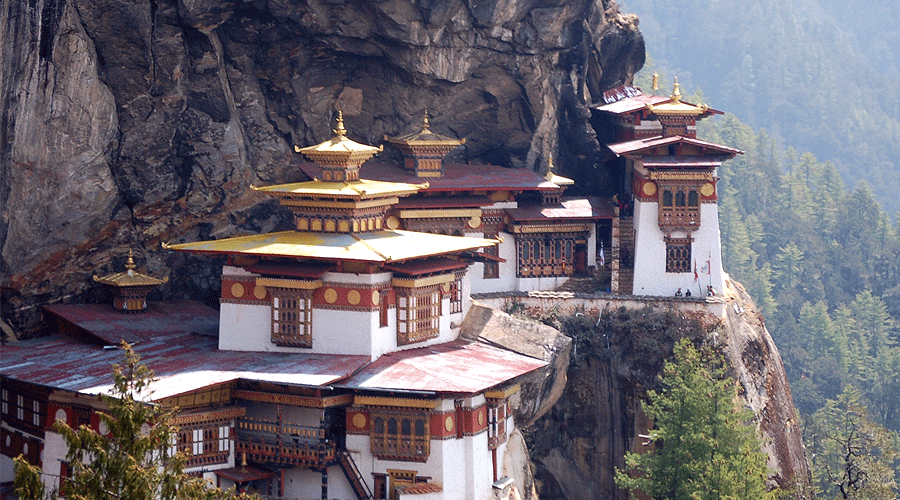
Bhutan is an exotic land of high mountains and lush valleys, snow-clad peaks and clear running springs, pristine ecology and an incredible wealth of wildlife. Trekking or hiking is an ideal way to discover this country. The highest peaks in the Himalayas form a border between Bhutan and the beginning of the Tibet known as Roof of the World". The tourism industry in Bhutan is founded on the principle of sustainability, ...See more
Bhutan is an exotic land of high mountains and lush valleys, snow-clad peaks and clear running springs, pristine ecology and an incredible wealth of wildlife. Trekking or hiking is an ideal way to discover this country. The highest peaks in the Himalayas form a border between Bhutan and the beginning of the Tibet known as Roof of the World". The tourism industry in Bhutan is founded on the principle of sustainability, meaning that tourism must be environmentally and ecologically friendly. First opened to tourists in 1974.Visitors may experience Bhutan only on all-inclusive package tours for which a fixed daily tariff is set by the Royal Government of Bhutan.
We arrange all packages of eco friendly tours and treks in Bhutan. Central and east west Bhutan tour is one of the popular tours in Bhutan. Eco Trip Nepal Treks & Expedition arrange according to travelers wish and desire.
Bhutan General Information
BY AIR
The best way to enter Bhutan is by Druk Air, Bhutan's National Flag carrier. Druk Air has flights from India (Delhi & Calcutta), Nepal (Kathmandu), Thailand (Bangkok) and Bangladesh (Dhaka). Druk Air is the only air operating to Bhutan.
BY LAND
By land, For travelers willing to visit Darjeeling, Sikkim and Nepal, serves as a best connecting point. Exit from Bhutan can be made from Samdrup Zongkhar also. This frontier town is approximately three hours drive from Guwahati, the capital city of Assam state of India. Samdrup Zongkhar is the only other authorised exit point in Bhutan from where you can make further visit to other parts of India.
VISA
A visa is required for traveling to Bhutan and it is processed and arranged by travel agents in Bhutan. No foreign mission grants tourist visa. Our partner agent in Bhutan will take care of your Visa preparation. Please download this Visa Application Form fill it carefully and mail it to us at least four weeks prior to date of your proposed travel, for processing it with the concerned authorities. Please include four copies of a recent passport size photographs. Actual visa is stamped on arrival in Bhutan while visa is cleared in advance and a visa clearance number issued. Once we've gone through this process and received a clearance number, we will confirm your travel.
CUSTOMS & REGULATIONS
The Bhutanese authorities strictly prohibit the export of any religious antiquity or antiques of any type. All personal electronics, cameras, video cameras, computers and personal electronic equipment may be brought into the country but they must be listed on the Customs form provided on arrival at Paro and will be checked on your departure. Two liters of Alcohol and reasonable quantity of cigarettes may be brought in to the country without duty.
CURRENCY
Bhutan's unit of currency is the Ngultrum (Nu), which equals 100 Chetrum’s. It is at par with the Indian rupee, itself a legal tender in the kingdom. One US dollar is exchanged for roughly 44 Ngultrum’s. Tourists can exchange traveler’s cheques or cash at the Bank of Bhutan or at any authorized hotels. US dollar, Australian dollars, pound sterling, Euro, and Swiss francs, Hong Kong dollars, Singapore dollars, Thai bath or Japanese yen are all accepted currencies.
ACCOMMODATION
Hotels vary in style and quality but are generally considered one of the welcome surprises for visitors. There is a variety of hotels in Bhutan, ranging from simple huts that cater to Bhutanese yak herders to Paro's fancy Olathang Hotel, which was built for royal guests. There is no International chain of hotels and not much imported hotel equipment. To be more precise, what you get is a Bhutanese version of what the tourists expect. In most cases, the facilities and service are good. The Tourism Authority of Bhutan approves the hotels for the International tourists.
PHOTOGRAPHY & VIDEO
The photography opportunities in Bhutan are immense. Photography is permitted nearly everywhere in Bhutan and the local population has no aversion to being photographed. If you wish to record the local people, their houses, shops etc, always ask by gestures if it is okay to do so. Photography inside the Dzongs and Monasteries are not permitted. Please follow our guide's instruction carefully while visiting Dzongs, monasteries and religious institution.